India's tinkering labs get an AI teaching assistant, powered by Gemini
Google DeepMind and the Atal Innovation Mission are piloting ATL Saathi in 100 schools, giving teachers a 24/7 planner that spits out project ideas, wiring diagrams and safety notes in eight languages.
Key points
- Google DeepMind and India's Atal Innovation Mission launched ATL Saathi on July 14, 2026, a Gemini-based web app for teachers in Atal Tinkering Labs.
- The pilot covers 100 schools, part of a network that reaches more than 11 million students across India.
- The assistant generates grade-appropriate project ideas, step-by-step assembly guides, wiring diagrams and safety precautions.
- It launches in eight Indian languages, with room to add more.
- It runs on Gemini 3.5 Flash, Google's faster, cheaper model tuned for quick responses.
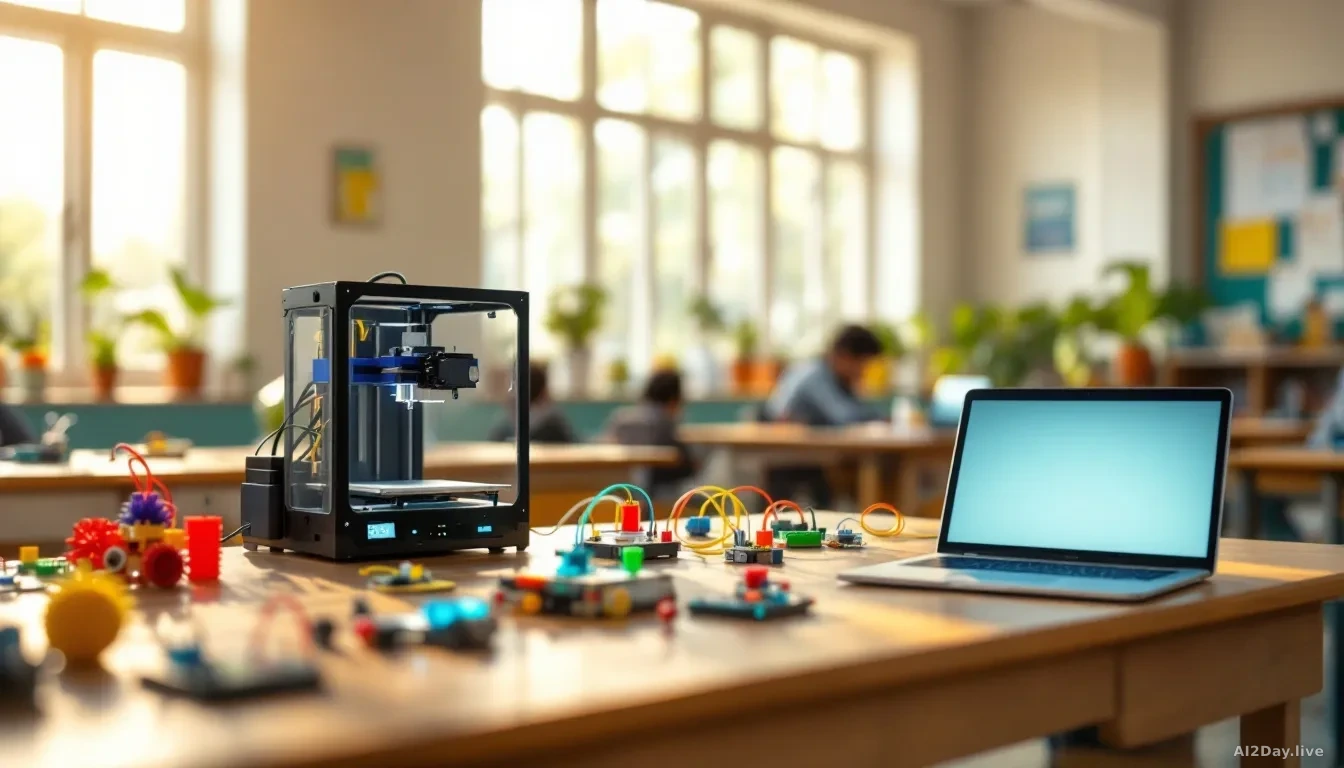
India has spent years building Atal Tinkering Labs, small school workshops kitted out with 3D printers, sensors and basic robotics kits. There are enough of them now to reach over 11 million students. The hard part was never the hardware. It was finding teachers who could confidently walk a curious 13-year-old through wiring up a soil-moisture sensor without setting the classroom on fire.
That is the gap Google DeepMind is trying to plug with ATL Saathi, a web app for teachers that launched in pilot on July 14, 2026.
Think of it as a patient co-teacher that never sleeps. A teacher opens the app, picks a module from the official tinkering curriculum, and gets a short summary, an infographic, a video overview and a quick quiz. No two-hour training video. No 80-page PDF.
The more interesting part is what happens when students turn up with an idea.
Say a student wants to build a device that warns a farmer when a water tank is nearly empty. The teacher types the problem into ATL Saathi. The app, running on Gemini 3.5 Flash (Google's fast, low-cost version of its main AI model, the technology behind chatbots like Gemini and ChatGPT), returns a project plan. That plan includes which components to pull off the shelf, a wiring diagram showing how to connect them, assembly steps, and safety notes about things like loose batteries and exposed wires.
It works the other way too. If a teacher wants to spark ideas rather than respond to them, the app generates project suggestions matched to the student's grade and the current syllabus.
Crucially, it does all this in eight Indian languages at launch. A teacher in a Tamil-medium school in rural Tamil Nadu gets the same wiring diagram and the same safety warnings as a teacher in an English-medium school in Delhi. The curriculum materials sit inside NotebookLM, Google's document-grounded AI tool, so the assistant is answering from the official Atal Innovation Mission playbook rather than the open internet.
The Atal Innovation Mission sits inside NITI Aayog, the Indian government's policy think tank. Its stated goal is to turn a million Indian children into what it calls "neoteric innovators". The partnership was first announced at the AI Impact Summit in February 2026, and Google DeepMind says today's launch is the first working product from that commitment.
What does this actually change for a classroom?
It shifts the teacher's job from hunting for information to guiding a student through it. A physics teacher who has never touched an Arduino board, the small programmable circuit board students use for electronics projects, can now walk into a lab with a printed plan, a parts list and a safety checklist generated in minutes.
Compare that to the human alternative. A specialist mentor visiting each of the thousands of tinkering labs across India is not affordable at national scale. Even one visit per school per term would run into serious money and logistics. A software assistant that costs pennies per query, running on a model designed for cheap high-volume use, is a very different economics problem.
There are real questions the pilot will need to answer. Do the wiring diagrams actually work when built? Do the safety warnings hold up when a 12-year-old ignores them? How often does the model invent a component that does not exist in the lab's kit?
The 100-school cohort is where those answers will come from. If Google DeepMind and the Atal Innovation Mission can show that teachers spend less time on paperwork and more time supervising actual builds, the case for scaling to the full tinkering lab network gets a lot easier to make.
For now, the tinkering labs have a new staff member. It answers at 2am, speaks eight languages, and never gets tired of the same question about resistors.